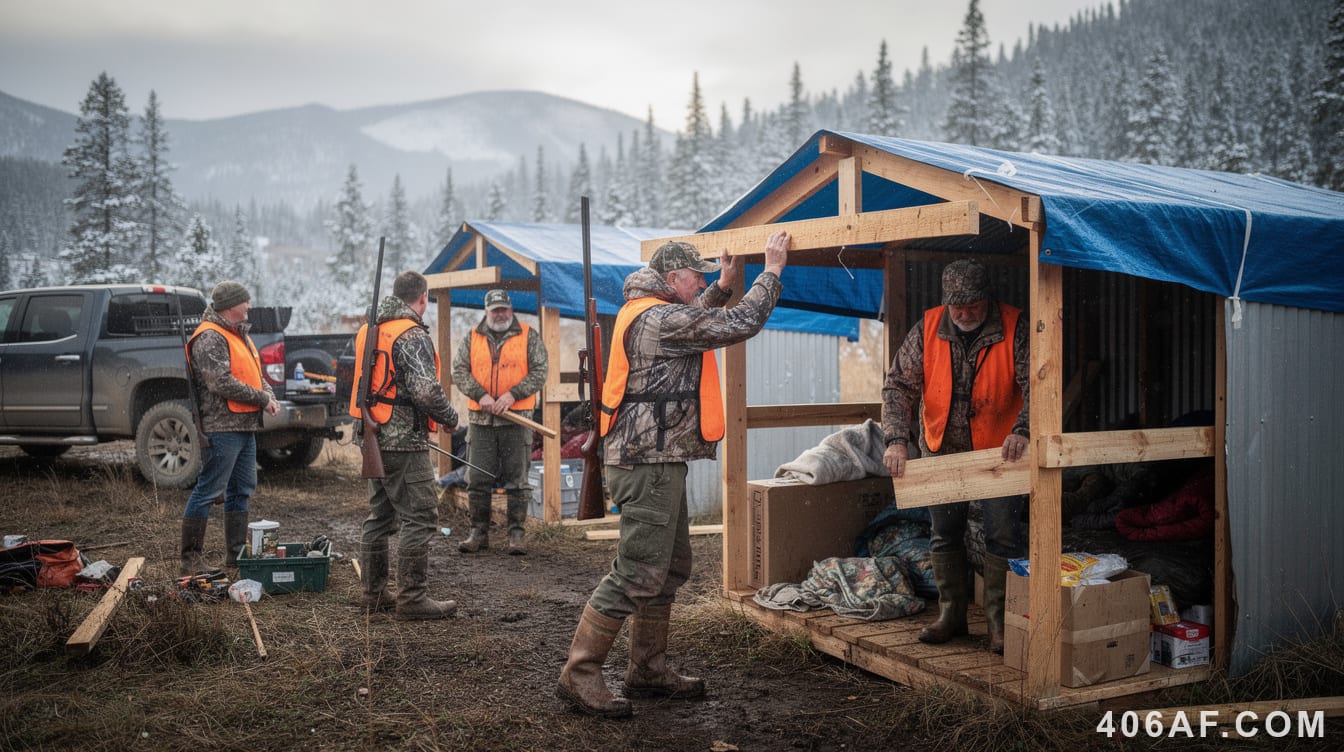
BOZEMAN, MT — A months-long investigation by 406AF has uncovered a disturbing conspiracy among Montana's elk hunters: Instead of spending their six-week hunting seasons getting blackout drunk in wall tents as their wives believe, thousands of men across the state are secretly volunteering at food banks, building affordable housing, and mentoring at-risk youth.
The investigation began when reporter Jake Matthews, posing as a typical elk hunter, infiltrated a remote camp outside Gardiner with hidden cameras and a cooler full of Busch Light. What he expected to find was a debauched scene of middle-aged men escaping their marital responsibilities through a haze of whiskey and poker games. Instead, he discovered something far more sinister.
"I walked into that wall tent expecting to see passed-out hunters and empty Pendleton bottles," Matthews said, visibly shaken. "But there were fucking spreadsheets everywhere. Volunteer schedules. Donation tracking forms. One guy was on a satellite phone coordinating a Habitat for Humanity build. It was honestly one of the most disturbing things I've witnessed in 15 years of investigative journalism."
According to Matthews' findings, the elaborate deception begins each September when archery season opens. Men across Montana kiss their wives goodbye, load their trucks with rifles, coolers, and camping gear, then drive to remote locations where they've established what appear to be typical hunting camps. But once the wall tents are erected and the wood stoves are burning, the real work begins.
Rick Hendrickson, a 52-year-old plumber from Kalispell who agreed to speak on condition of anonymity, explained the complex web of lies. "Look, if I told my wife I was spending three weeks sorting donated food at the Montana Food Bank Network, she'd think I'd lost my goddamn mind," he said, nervously adjusting his blaze orange vest. "But if I tell her I'm going elk hunting? She just rolls her eyes and says 'don't come back without meat for the freezer.' It's the perfect cover."
The scale of the deception is staggering. Matthews' investigation revealed that during the 2025 hunting season alone, men claiming to be elk hunting actually contributed over 45,000 volunteer hours to various nonprofits across the state. The Montana Nonprofit Association, when presented with the data, initially refused to believe it.
"We always wondered why volunteer numbers spiked so dramatically from September through November," said Patricia Kellman, a fictional director at the Montana Nonprofit Association. "We just assumed it was retirees with extra time. To learn it's actually hunters living a double life? Jesus Christ, what the fuck is wrong with these people? Why can't they just admit they want to help their community?"
The hunters' methods are sophisticated. They maintain elaborate props including dirty camo clothing, game calls, and even purchase elk meat from local ranchers to bring home as "proof" of their hunting success. Social media accounts are carefully curated with photos of sunrise mountain vistas and tracks in the snow, while the men are actually spending 12-hour days repacking rice at food banks or teaching disadvantaged youth how to read.
Tom "Big Tom" Jacobsen, a 47-year-old insurance adjuster from Billings, broke down when confronted with evidence of his volunteer work. "You don't understand the pressure," he said, tears streaming into his beard. "My dad was a real hunter. Killed three elk every season, drank a fifth of Jim Beam daily, and died of cirrhosis at 58 like a real Montana man. How am I supposed to tell him I spent my elk season teaching financial literacy at the homeless shelter? He'd fucking disown me from beyond the grave."
The investigation took an even darker turn when Matthews discovered that some hunting camps were actually fronts for extensive charitable operations. One camp near Phillipsburg had converted their wall tent into a makeshift medical clinic, providing free healthcare to underserved rural communities. Another group outside Ennis was secretly building tiny homes for veterans experiencing homelessness.
"The worst part is how good they've gotten at hiding it," Matthews explained, showing photos from his undercover work. "They'll spend all day volunteering, then gather around the campfire at night practicing their cover stories. 'Yeah, saw a big six-point but couldn't get a clean shot.' 'Wind was swirling, spooked the whole herd.' Meanwhile, they'd actually spent the day delivering food boxes to elderly shut-ins."
When confronted with these findings, many wives expressed a mixture of shock, betrayal, and confusion. Karen Williamson of Missoula discovered her husband had been secretly volunteering at the Missoula Food Bank throughout what he claimed were "unsuccessful" hunting seasons for the past eight years.
"I'm just... I don't even know how to process this," she said, clutching a photo of her husband helping at-risk youth. "All those nights I complained about him being gone, worried he was out there drunk with his buddies, possibly cheating on me with some lot lizard at a truck stop. And instead, he was... he was packing food boxes for hungry families? That lying piece of shit. How dare he make me think he was just another selfish asshole when he was actually being a productive member of society?"
The hunters themselves seem unable or unwilling to stop their deceptive behavior. Support groups have formed in wall tents across the state where men gather to discuss their compulsive volunteering. "Hi, my name is Dale, and I've been secretly helping my community for seven years," one man said to a circle of nodding heads around a camp stove. "Last week I almost told my wife about the literacy program I started, but then I remembered I'm supposed to be a drunk, worthless hunter. So I made up a story about missing a massive bull and drank a beer in the garage to keep up appearances."
Dr. Rebecca Martinez, a fictional psychologist at Montana State University, has studied the phenomenon. "It's a fascinating case of toxic masculinity turned inside out," she explained. "These men are so terrified of appearing weak or caring that they've created elaborate hunting personas to hide their charitable work. They'd rather be seen as drunken, absent failures than admit they give a shit about their communities. It's simultaneously the most Montana thing I've ever studied and the most fucked up."
As news of the investigation spread, emergency meetings were called in hunting camps across the state. One source reported panicked hunters burning volunteer schedules and donation receipts while hastily setting up poker tables and opening whiskey bottles to maintain their covers. Several camps reportedly staged fake drinking contests when wives showed up unexpectedly, with men forcing themselves to act belligerent to avoid suspicion.
Despite overwhelming evidence, including photos, financial records, and testimony from nonprofit directors, many of the accused hunters continue to deny the allegations. When pressed about his whereabouts during hunting season, Bob Richardson of Great Falls became aggressively defensive.
"I don't know what kind of bullshit liberal conspiracy you're trying to push here," Richardson shouted, his face red with anger. "I spent six weeks in the Bob Marshall Wilderness drinking whiskey and failing to shoot elk like my father and his father before him. I didn't teach a single underprivileged kid to read. I didn't serve a single meal at any goddamn shelter. And I sure as fuck didn't spend my evenings knitting blankets for premature babies at the NICU, no matter what that photo clearly shows me doing!"
Matthews, who spent three months embedded in the hunting camps, said the experience has forever changed his perspective on Montana hunters. "These men are living complete double lives," he said. "By day, they're building wheelchair ramps and tutoring struggling students. By night, they're practicing their stories about the one that got away. It's like Fight Club, but instead of beating each other up, they're secretly making their communities better places. And the first rule is: you do not talk about volunteering."
Local businesses that cater to hunters report suspicious purchasing patterns that, in hindsight, support Matthews' findings. Jim Paulson, who owns a sporting goods store in Bozeman, said he "should have known something was off" when hunters kept buying brand new gear but never seemed to need ammunition.
"They'd come in, drop two grand on camo and camping equipment, buy one box of shells, then leave," Paulson recalled. "I just figured they were really bad shots. Now I realize that box of ammo was probably sitting untouched while they were out there teaching job skills to recovering addicts. It makes me sick. These libtards infiltrated hunting season with their 'helping others' agenda."
As this story went to press, the Montana Department of Fish, Wildlife and Parks announced they were "investigating the situation" but noted that technically, purchasing a hunting license to secretly volunteer doesn't violate any regulations. "As long as they're not exceeding bag limits on charity work, we can't really do anything," a spokesperson said.
Matthews concluded his investigation with a stark warning: "If your husband says he's going elk hunting for weeks at a time but comes back seeming fulfilled and at peace with himself instead of drunk and disappointed, he might be secretly volunteering. Check his gear for hidden donation receipts. Ask him specific questions about wind direction and bullet trajectories. And whatever you do, don't let him know that you know. These men are fragile and might completely break down if forced to admit they care about something other than killing large mammals."
For now, Montana's elaborate hunting season charity conspiracy continues unabated. As one anonymous hunter put it while loading canned goods into his truck: "Let my wife think I'm a drunk, worthless piece of shit wasting money on hunting trips. It's better than her finding out I have feelings and want to make the world a better place. Can you imagine? I'd never hear the end of it."